
What Is the Montessori Method — and Why Does It Work at Home?
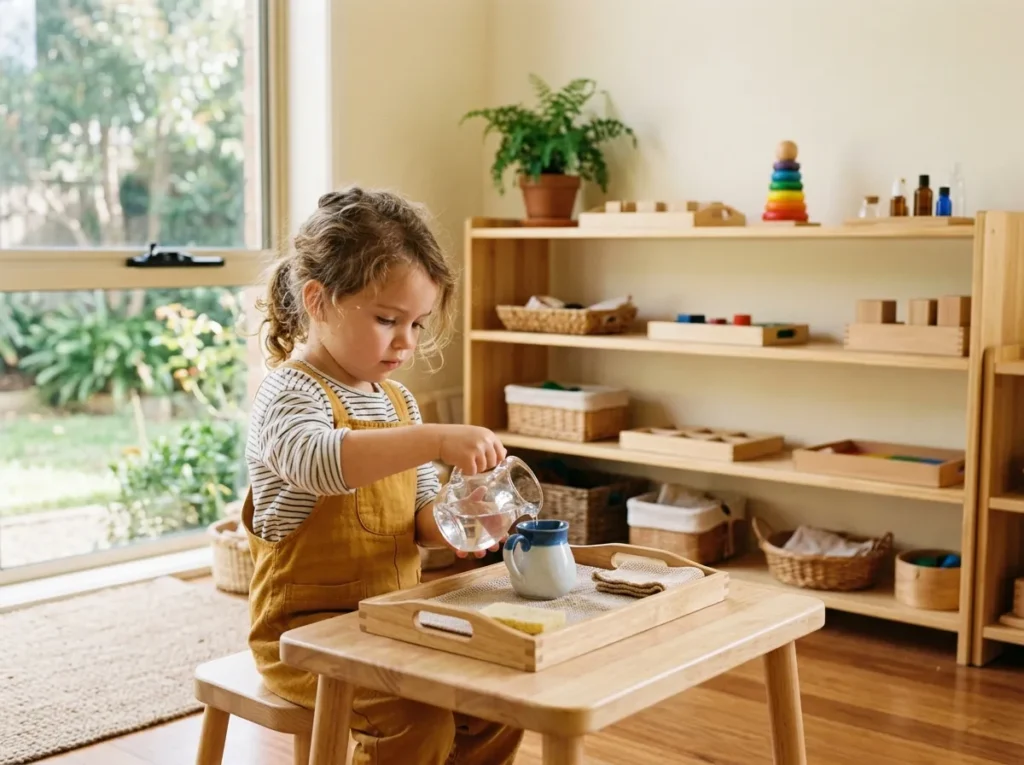
If you have ever watched your preschooler quietly focus on pouring water from one cup to another for ten uninterrupted minutes, you have already witnessed the Montessori method in action. Developed in the early 1900s by Italian physician and educator Dr. Maria Montessori, this approach is built on one powerful idea: children are naturally driven to learn when given the right environment and the freedom to explore it.
The Montessori method is not a rigid curriculum. It is a philosophy — one that respects the child as a capable, curious individual who learns best through hands-on experience, real-world tasks, and self-directed discovery. According to the American Montessori Society, children in Montessori environments develop independence, confidence, and a deep love of learning by engaging with thoughtfully prepared materials and activities at their own pace.
The good news for parents? You do not need to enroll your child in a Montessori school to bring these principles into your daily life. Many of the most powerful Montessori activities for preschoolers at home require nothing more than everyday household items and a willingness to slow down and let your child lead.
At Preschool With Mommy, we believe that learning happens best when it is joyful, purposeful, and rooted in the parent-child relationship. Montessori principles align beautifully with that vision. In fact, as we explore in The Importance of Play in Preschool Development, children grow most when learning feels like play — and Montessori activities do exactly that.
The Core Principles Behind Montessori Activities
Before diving into specific activities, it helps to understand the key ideas that make Montessori so effective for young children. When you know the “why” behind an activity, you can apply it across your entire day — not just during designated learning time.
Child-Led Learning
In Montessori, the child chooses what to work on within a prepared range of options. This fosters intrinsic motivation — the internal drive to learn because it feels meaningful, not because someone told them to. When your preschooler chooses to sort buttons by color, they are not just playing. They are building concentration, decision-making, and early math skills on their own terms.
The Prepared Environment
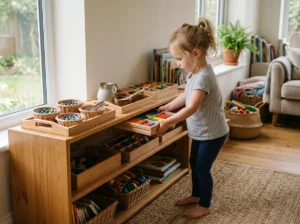
Montessori environments are carefully arranged to be accessible, beautiful, and inviting to the child. At home, this means low shelves, child-sized tools, and materials that are visible and within reach. When a child can independently access and return their own materials, they develop a sense of ownership and responsibility for their space.
Practical Life as Learning
One of the most distinctive features of Montessori is the emphasis on practical life activities — the everyday tasks of real living. Sweeping, pouring, folding, and preparing food are not chores to keep a child busy. They are foundational learning experiences that build fine motor skills, concentration, sequencing ability, and deep confidence.
Freedom Within Limits
Montessori does not mean “anything goes.” Children are given freedom within a clear and loving structure. They choose their activity, but they treat materials with care, complete a task before moving on, and return things to their place when finished. This balance between freedom and responsibility is at the heart of how Montessori builds self-regulation.
10 Montessori Activities for Preschoolers at Home
The following activities are drawn directly from Montessori’s practical life and sensorial areas — the two categories most appropriate for children ages 2.5 to 5. None of them require expensive kits or special equipment. Most use items you already have at home.
1. Pouring and Transferring
Set up a small tray with two identical pitchers or cups. Fill one with water (or dried rice or lentils for a mess-free version) and show your child how to carefully pour the contents from one to the other. This deceptively simple activity builds hand-eye coordination, wrist control, concentration, and the ability to self-correct when they spill.
Once your child masters a basic pour, introduce a small sponge for cleanup — another Montessori staple that teaches responsibility and care for the environment.
2. Spooning and Scooping
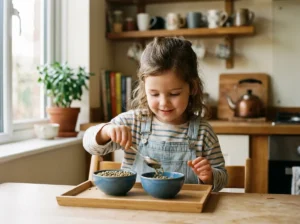
Place two small bowls side by side on a tray. Fill one with dried chickpeas, pom-poms, or wooden beads. Provide a spoon and show your child how to transfer the objects from one bowl to the other, one scoop at a time. Vary the spoon size and object size to increase difficulty as their skill grows.
This activity strengthens the pincer grip, which is directly linked to later handwriting readiness.
3. Sorting by Color, Size, or Shape
Gather a collection of everyday objects — buttons, colored wooden pegs, pebbles, or even different types of dried pasta. Provide a muffin tin, small bowls, or a sorting mat and invite your child to group the objects by one characteristic. Do not tell them which rule to follow — let them choose. You may be surprised what sorting criteria they come up with on their own.
4. Washing Dishes or Produce
This is a classic Montessori practical life activity. Set up a small basin of soapy water, a soft brush, and a drying cloth. Give your child a few unbreakable dishes, small cups, or even some fruit and vegetables to wash. The sequential steps — wash, rinse, dry, put away — build executive function skills alongside concentration and a genuine sense of contribution to the household.
5. Folding Cloths
Cut a few small squares of fabric or use clean washcloths. Show your child how to fold them in half, then in half again. Start with a simple fold and progress to more complex ones as their coordination improves. Folding builds bilateral coordination, spatial awareness, and patience — and preschoolers love the satisfaction of a neat, finished stack.
6. Object-to-Object Matching
Gather pairs of matching objects from around your home — two identical spoons, matching socks, two of the same block. Mix them up on a tray and invite your child to find the pairs. You can also use picture-to-object matching by printing simple photographs of household items and asking your child to match them to the real thing.
This activity builds visual discrimination, memory, and early language skills as your child names what they find.
7. Sensory Bins with a Purpose
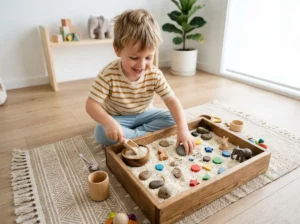
Fill a shallow bin or tray with a base material — dried rice, sand, or dried corn — and hide small objects inside. Provide scoops, small tongs, and containers. The goal is not just sensory play (though that is valuable in itself) but purposeful exploration: can your child use the tongs to retrieve only the wooden shapes? Can they sort what they find into categories?
For more ways to use natural materials in sensory play, our guide to Outdoor Nature Sensory Play Ideas for Preschoolers is a great companion resource.
8. Dressing Frames
Zipping, buttoning, snapping, and tying are Montessori staples. If you do not have a formal dressing frame, simply use clothing your child already owns — a shirt with large buttons, a jacket with a zipper, shoes with Velcro. Slow down during dressing time and turn it into a learning moment. Show the motion once, then step back and let your child try. Resist the urge to help before they ask.
Mastering their own clothing builds independence, fine motor control, and enormous self-confidence.
9. Simple Food Preparation
Welcoming your preschooler into the kitchen is one of the most powerful Montessori practical life invitations you can offer. Start simple — spreading butter on bread with a child-safe spreader, peeling a banana, tearing lettuce for a salad, or rinsing strawberries. Provide child-sized tools where possible and real utensils rather than toy versions.
Children who help prepare food are more likely to try new foods, develop a healthy relationship with eating, and feel genuinely proud of their contribution to the family. As a bonus, these activities connect beautifully to the nutrition-focused dimension of your child’s development — something we highlight in the Superfoods section of our program at Preschool With Mommy.
10. Nature Observation Journals
Give your preschooler a simple blank notebook and some crayons. Take a slow walk outdoors — even just around your garden or a nearby park — and invite them to draw what they notice: a leaf, a bug, a flower, a cloud. Do not correct their drawings. Ask open questions: “What shape is that leaf?” “How many legs does that bug have?” “What color do you think that flower is?”
This activity cultivates observation skills, scientific thinking, early writing habits, and a deep connection to the natural world — all Montessori essentials. Pair it with the ideas in our Outdoor Nature Sensory Play guide for a full nature-based learning experience.
How to Set Up a Montessori-Friendly Space at Home
You do not need to redesign your entire house. A few thoughtful adjustments can create a home environment that supports independent, Montessori-style learning every day.
Use Low, Open Shelves
Place a few activities on a low shelf at your child’s eye level. Rotate the materials every week or two to maintain interest. The key is that your child can see, access, and return everything independently — without needing to ask for help.
Prepare Activities on Trays
Trays define a workspace and contain materials in a way that communicates care and order. A simple wooden or plastic tray signals to your child: this is complete, this is ready, this is yours to use. It also makes cleanup intuitive — everything goes back on the tray.
Limit Choices
More is not better in a Montessori home. Three to five activities available at a time is plenty. Too many options overwhelm young children and reduce concentration. Rotate materials regularly so the shelf always feels fresh and appealing.
Slow Down and Observe
The hardest Montessori practice for most parents is this: step back. Watch before you intervene. Give your child the gift of struggling productively. When we rush to help, we accidentally communicate that we do not believe they can do it themselves. When we wait — with warm, patient presence — we communicate exactly the opposite.
This principle connects directly to what we discuss in How to Create a Stimulating Learning Environment for Your Preschooler — that the best learning spaces are designed to support the child’s independence, not replace it.
Common Questions About Montessori at Home
Do I Need to Buy Expensive Montessori Materials?
No. The activities in this post use items you likely already have: small bowls, spoons, dried foods, fabric scraps, and outdoor materials. While beautiful wooden Montessori materials are wonderful if you choose to invest in them, the philosophy is entirely achievable on a budget. The American Montessori Society’s guide to Montessori at home emphasizes that real household tools and natural materials are often more effective than expensive toy versions.
How Long Should a Montessori Activity Last?
Follow your child’s lead. A three-year-old may pour water back and forth for twenty minutes — this is not unusual. Do not interrupt a child who is deeply concentrated, even if the activity seems repetitive to you. Concentration is the goal. Conversely, if your child finishes in two minutes and moves on, that is fine too. There is no required duration.
What If My Child Does the Activity “Wrong”?
In Montessori, materials are designed so that the child can notice and correct their own errors. Resist the urge to correct immediately. Instead, observe. If they are frustrated, you can gently demonstrate once and then hand control back to them. The learning happens in the doing — including in the mistakes.
How Is This Different from Regular Play?
Montessori activities are purposeful and connected to real life. They have a clear beginning, middle, and end. They involve real tools, real tasks, and real consequences (spilled water is mopped up, not ignored). This is different from open-ended creative play — and both have their place. Montessori activities build the specific skills of independence, coordination, concentration, and sequencing in a way that purely imaginative play does not.
Bringing It All Together
You do not need a perfectly curated shelf or a dedicated learning room to bring Montessori principles into your home. You need a willingness to slow down, trust your child, and invite them into the real work of daily life. The ten activities above are a starting point — a gentle invitation to experience what happens when you give a preschooler the tools, the space, and the time to discover what they are capable of.
At Preschool With Mommy, we have always believed that the most powerful learning happens in the relationship between parent and child. Montessori at home is not about perfection. It is about presence — about showing up alongside your little one with curiosity, patience, and genuine delight in who they are becoming.
Start with one tray. One activity. One slow, unhurried morning. That is all it takes to begin.