
If you have ever watched your preschooler build a tower with blocks, pour water between cups, or ask endless questions about how things work, you have already witnessed the beginnings of STEM learning. Science, Technology, Engineering, and Math might sound like subjects for older kids, but the truth is that young children are natural scientists. They explore, experiment, and discover every single day — and with the right activities, you can turn that curiosity into meaningful learning moments.
The best part? You do not need fancy equipment or a science degree to introduce STEM activities for preschoolers at home. With simple household items and a little creativity, you can spark a love for learning that will last a lifetime. In this guide, we will share 15 easy and engaging science experiments you can do together — no lab coat required.
Why STEM Matters for Preschoolers
You might wonder whether preschoolers are really ready for STEM learning. The answer is a resounding yes. According to ZERO TO THREE, early STEM activities can increase the likelihood that children enter kindergarten with a strong foundation in critical thinking and problem-solving skills. Even more importantly, these experiences help build a positive STEM identity — the belief that science and math are something they can do and enjoy.
When preschoolers engage in hands-on experiments, they are not just having fun. They are developing skills that will serve them throughout their education and beyond. Activities like mixing colors, building structures, and observing nature teach children to ask questions, make predictions, test ideas, and draw conclusions. These are the building blocks of scientific thinking.
As we explored in The Importance of Play in Preschool Development, play is how young children learn best. STEM activities take that natural playfulness and channel it into purposeful exploration. The result is learning that feels like fun — because it is.
Simple Science Experiments to Try at Home
You do not need expensive kits or complicated instructions to bring STEM into your home. These experiments use everyday materials you probably already have in your kitchen or craft drawer.
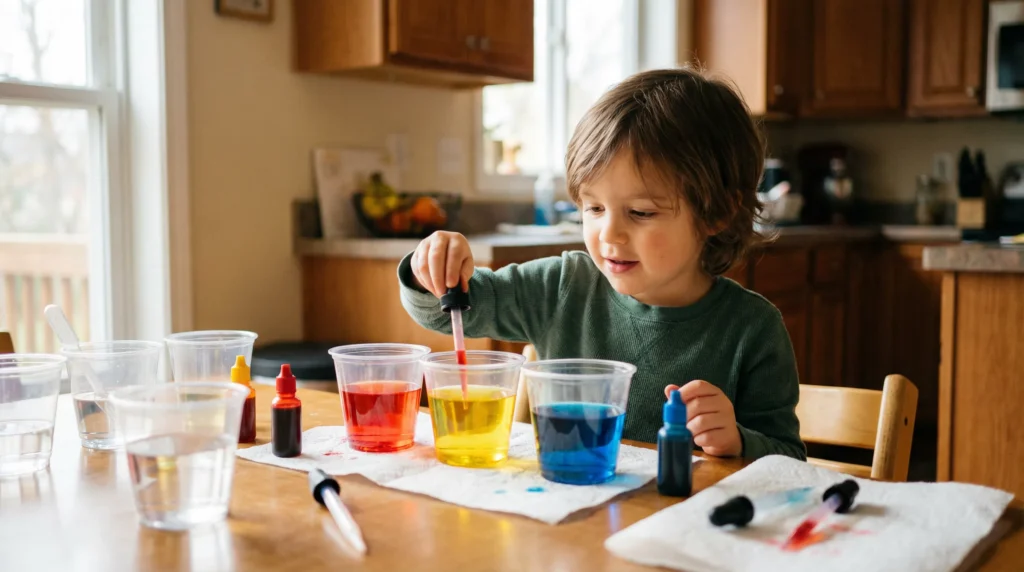
Color Mixing Magic
Fill three clear cups with water. Add red food coloring to one, yellow to another, and blue to the third. Give your child a dropper or small spoon and let them mix colors in empty cups. What happens when red meets yellow? When blue meets red? This simple activity introduces primary and secondary colors while building fine motor skills.
Sink or Float Discovery
Gather a variety of household objects — a wooden block, a metal spoon, a plastic toy, a cork, a small rock. Fill a large bowl or basin with water. Before dropping each item in, ask your child to predict whether it will sink or float. Then test it together and discuss why some things float while others sink. This experiment introduces concepts of density and buoyancy in a way preschoolers can understand.
Baking Soda Volcano
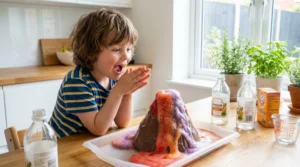
This classic experiment never gets old. Place a small container in a tray or dish to catch overflow. Add a few tablespoons of baking soda, a squirt of dish soap, and a few drops of food coloring. When your child pours in vinegar, watch the fizzy eruption together. Talk about what is happening — the chemical reaction between the acid and base creates carbon dioxide gas, which makes the bubbles.
Ice Cube Rescue
Freeze small toys or natural objects like leaves and flowers inside ice cubes or a larger block of ice. Give your child tools like spoons, droppers with warm water, and salt to “rescue” the items. This activity teaches patience, problem-solving, and introduces concepts about how temperature affects solid and liquid states.
Magnet Exploration
Give your child a magnet and let them explore your home to discover what it sticks to. Create a simple chart with two columns — “magnetic” and “not magnetic” — and help them sort their findings. This introduces the concept of magnetism and encourages observation and classification skills.
Building and Engineering Challenges
Engineering for preschoolers does not mean complicated blueprints. It means giving children opportunities to design, build, test, and improve their creations. These activities develop spatial awareness, problem-solving skills, and persistence.
Marshmallow and Toothpick Structures
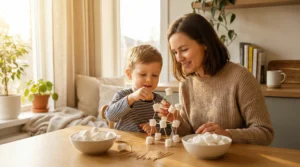
Provide mini marshmallows and toothpicks and challenge your child to build the tallest tower they can. What happens when the tower gets too tall? How can they make it more stable? This simple activity introduces basic engineering concepts like balance, structure, and trial-and-error problem-solving.
Block Tower Challenge
Use wooden blocks, cardboard boxes, or even empty food containers to build towers and structures. Encourage your child to experiment with different arrangements. Ask questions like “What happens if you put the big block on top?” or “Can you make a bridge between two towers?” As noted in How to Create a Stimulating Learning Environment for Your Preschooler, open-ended building materials encourage creativity and critical thinking.
Cardboard Box Creations
Save cardboard boxes of different sizes and let your child design and build whatever they imagine — a car, a robot, a house for stuffed animals. Provide tape, markers, and scissors (with supervision) and let their creativity flow. This process teaches planning, spatial reasoning, and persistence when things do not work the first time.
Ramp Races
Create simple ramps using books, cardboard, or wooden boards. Let your child roll different objects down the ramp — toy cars, balls, wooden blocks. Which objects roll fastest? Does the angle of the ramp make a difference? This hands-on experiment introduces concepts of gravity, friction, and motion.
Outdoor STEM Exploration
Nature is one of the best classrooms for young scientists. Outdoor exploration engages all five senses and connects children to the world around them.
Nature Scavenger Hunt
Create a simple list of items to find — something rough, something smooth, a leaf, a rock, something that makes a sound. As your child searches, talk about the properties of each item. This activity builds observation skills and introduces early classification concepts. For more outdoor ideas, explore our guide to Outdoor Nature Sensory Play Ideas for Preschoolers.
Shadow Tracing
On a sunny day, place toys or objects on paper and trace their shadows. Return later in the day and trace again. How have the shadows changed? This simple activity introduces concepts about light, the sun’s movement, and how shadows are formed.
Bug Observation
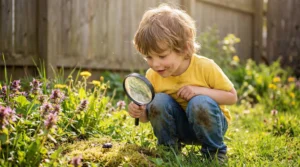
Find a safe spot in your yard or local park to observe insects. Use a magnifying glass if you have one. Count the legs on a bug. Watch how ants move in a line. Talk about what the insects are doing and why. This gentle introduction to biology nurtures respect for living things and builds scientific observation skills.
Kitchen Science Fun
The kitchen is a treasure trove of STEM learning opportunities. Cooking and baking naturally involve measuring, mixing, and observing changes — all key science concepts.
Making Butter
Pour heavy cream into a jar with a tight lid. Let your child shake it — for a long time. Eventually, the liquid cream transforms into solid butter. This magical transformation teaches about states of matter and the science behind emulsions. Plus, you get a tasty snack at the end.
Growing Seeds
Plant a few bean seeds in clear plastic cups filled with damp cotton balls or soil. Place them in a sunny window and water regularly. Watch together as roots and sprouts emerge over the following days. This long-term experiment teaches patience, responsibility, and the basics of plant biology.
Exploring Density with Liquids
Layer different liquids in a clear glass — honey, dish soap, water, and vegetable oil. Watch how they separate into distinct layers based on density. Drop small objects in to see where they settle. This visually striking experiment introduces the concept that different materials have different densities.
Tips for Making STEM Fun at Home
The key to successful STEM activities for preschoolers is keeping things playful and pressure-free. According to the National Association for the Education of Young Children (NAEYC), the most important thing adults can do is nurture children’s natural curiosity rather than rushing to explain concepts or correct mistakes.
Here are some tips to make STEM learning enjoyable for both you and your child:
Follow their lead. If your child is fascinated by bugs, plan more outdoor exploration. If they love water play, focus on sink-or-float experiments. Building on their interests keeps engagement high.
Ask open-ended questions. Instead of explaining what will happen, ask “What do you think will happen?” and “Why do you think that happened?” This encourages scientific thinking and helps children articulate their observations.
Embrace the mess. Science experiments can be messy, and that is okay. Lay down a plastic tablecloth or take activities outside when possible. The mess is often where the best learning happens.
Celebrate mistakes. When an experiment does not work as expected, treat it as a learning opportunity. Ask “What could we try differently?” This teaches resilience and the scientific process of trial and error.
Keep it short and sweet. Preschoolers have short attention spans. A 10 to 15 minute activity is often just right. End while they are still engaged so they look forward to the next experiment.
Building a Foundation for Lifelong Learning
When you engage your preschooler in simple science experiments and STEM activities, you are doing more than keeping them entertained. You are building neural connections, fostering curiosity, and teaching them that learning is fun. These early experiences shape how children approach challenges and new information throughout their lives.
The experiments we have shared require no special training or expensive materials — just your time, attention, and willingness to explore alongside your child. Whether you are mixing colors at the kitchen table, building towers on the living room floor, or hunting for bugs in the backyard, you are giving your preschooler the greatest gift: the confidence to ask questions, try new things, and discover answers for themselves.
So gather some baking soda, pull out the blocks, and head outside with a magnifying glass. Science is everywhere, and your little one is ready to explore it — one experiment at a time.